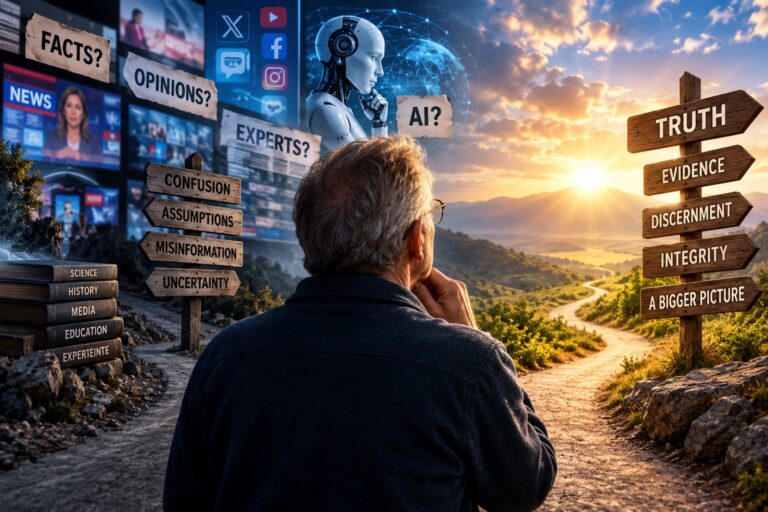
Do you believe in something because you have examined the evidence, because someone you trust told you, or because you have heard it so often that it simply feels true?
Somewhere along the way, what once felt dependable to me no longer felt quite as steady. Institutions I had relied on, voices I had trusted, even people I thought I understood seemed less certain than before—not alarmingly so, just enough to make me pause.
That pause began showing up in ordinary moments. Reading the news. Listening to experts. Watching public conversations unfold. Much of what I encountered was not clearly false, yet it somehow seemed less settled.
I began asking a question I had never needed to ask so deliberately before:
How do I decide what is really true—and whom I can trust?
Life moves faster now. Information arrives constantly and convincingly. Voices compete, explanations pile up, and there is little time to examine what we hear before the next claim appears.
Artificial intelligence has made that problem even clearer to me. I use AI regularly to gather information, explore ideas, and gain perspective. I check sources when I can. But what about the information I do not personally verify? Is it accurate? Can I trust it?
That problem is hardly limited to AI.
Over the years, I have become increasingly aware that nearly all information advances a “story.” Facts may be accurate, but they are selected, arranged, and interpreted within some larger framework.
Who shaped the message I am hearing? What assumptions lie behind it? Can the claim be tested or confirmed? And beneath those questions is a deeper one: Is there any stable standard by which truth itself can be judged?
My understanding of trust began much earlier than in the digital age. As a child, I trusted my grandparents. Later I trusted teachers, mentors, church leaders, professors, and others—not simply because they knew things, but because I believed they were people of integrity.
We still depend upon such trust. None of us can personally verify everything we believe.
But trust and truth are not the same thing.
Over a lifetime in engineering, I learned to examine assumptions, test claims, and recognize the limits of models. Newtonian mechanics is an excellent example. Newton’s laws describe the physical world extremely well within their applicable range. Einstein later demonstrated that Newton’s model was not adequate to describe all physical reality.
A model can work remarkably well and still not describe the whole of reality.
That same principle has increasingly shaped how I think about worldview.
A broadly naturalistic secular worldview generally begins with the material world and seeks truth through observation, evidence, reason, and human judgment. A biblical worldview begins with a different premise: that the material world is real, but it is not all that is real. God exists, has created the world, and has revealed truth about Himself, humanity, and the purpose of life.
The difference is fundamental because our starting assumptions influence how we interpret everything that follows.
It has helped me to separate three questions:
What is true?
How do I determine whether a claim is true?
Whom or what should I trust?
Those questions overlap, but they are not identical.
Truth concerns reality. Evidence helps us evaluate claims about reality. Trust determines whose testimony we are willing to rely upon when we cannot examine everything ourselves.
As a retired Professor Emeritus of Engineering, I remain committed to evidence, careful reasoning, and testing assumptions. But those habits eventually lead me to an even larger question:
What kind of world am I actually living in?
Is reality ultimately limited to the material processes we can observe and measure?
Or are we living in a world created by God, where material reality is genuine but not the whole of reality?
How we answer that question influences not only what we believe, but how we decide what is true and where we finally place our trust.
Trust cannot mean believing everything.
But discernment cannot mean trusting nothing.
Perhaps our challenge is learning once again how to do both: to think carefully and to know where our trust ultimately belongs.